OVERVIEW
Night and Day centers on Ethiopian journalist and author Baalu Girma's controversial 1984 Amharic novel Oromay, written under Ethiopia’s Derg regime and banned shortly after its publication. Drawing on artist Eric Gottesman's longstanding engagement with the novel, the exhibition considers how artists create, communicate, and sustain cultural memory within and against conditions of censorship, political repression, and state violence.
The exhibition's title comes from Girma's own divided existence. By day, he worked at his desk writing propaganda for the Derg; by night, at his kitchen table, he wrote fiction in longhand on yellow legal pads. In Oromay, Girma drew on that same duality as a literary strategy, blending fact and fiction and borrowing techniques from Ethiopian poetic traditions like qine to encode political meaning beneath the surface of his prose, saying one thing while also saying another. Oromay stands as both a case study and a blueprint for fiction's capacity to interrogate power, not only under the Derg, but under oppressive political regimes more broadly.
Since 2011, Gottesman has developed a series of translations, interpretations, and adaptations of Oromay. In 2012, working with Yawoinshet Masresha and Girma's family, he co-published the first authorized translation of the novel, and only the second translation of any Amharic novel into English. In the years since, he has collaborated with designers, artists, writers, and filmmakers across Ethiopia, Eritrea, and the United States to translate the novel and the story of its author into new forms, including photography, video installation, collaborative workshops, works on paper, and sculpture.
“The legacy of this single book has obsessed me for over a decade. Girma’s storytelling, and his commitment to it despite the risks, serves as a gift and a lesson to artists working in various disciplines and in contexts where creativity can be seen as a threat,” says Eric Gottesman.
Night and Day asks a question Gottesman considers particularly urgent in the United States today: what can we do with a banned book? Using translation, strategies of doubling, and reciprocal viewing, the exhibition treats Girma's writing not only as inspiration but, at times, as raw physical material, examining how art can construct what Gottesman calls a politics of possibility. Taken together, the works on view ask what Girma's writing reveals about the risks artists take to speak freely, in the Ethiopia where he wrote and in the United States today, where freedom of expression is likewise under duress.
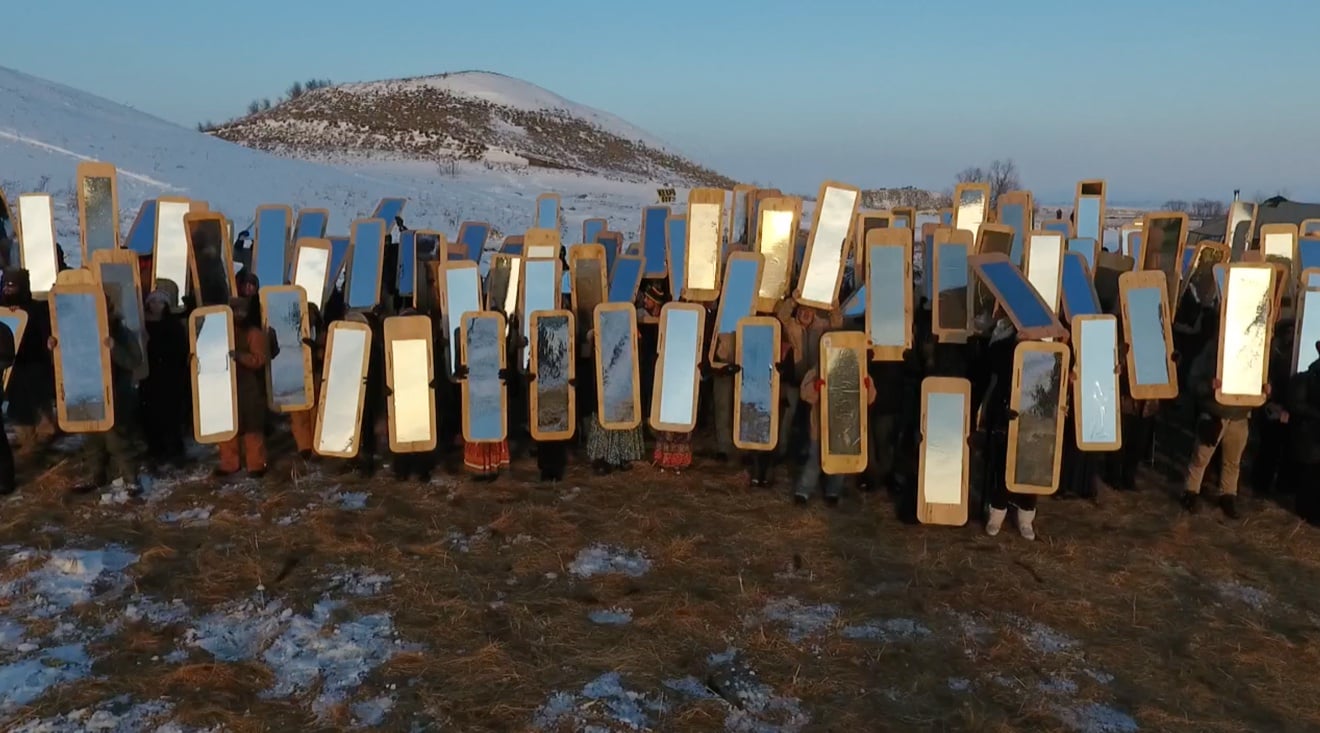
The exhibition brings together photography, video, sculpture, and works on paper spanning two decades of Gottesman's engagement with Oromay. Its title work, Night and Day / ቅነ ጥሬጰዛ, a kinetic sculpture created with designer Jomo Tariku and artist Adiskidan Ambaye, combines plywood, etched acrylic, scrolls of cotton, paper, and thread, pigment prints, and a motion-sensing motor. Baalu Girma's Portrait, a three-channel video installation, draws on interviews with the author's wife, Almaz, his daughter, Meskerem Girma, and his best friend, Abiyi Ford, offering a rare, intimate portrait of the man behind the novel. Other works draw directly on the physical object of the book itself: Flag incorporates screenprinting on pages of the banned novel, while Untitled Drawings, rendered in graphite on legal pad paper, echoes the yellow legal pads on which Girma wrote Oromay by night. Additional works include the films Colonel's Mirror (2017) and Elilta and Fiammeta (2026); My Flesh and My Soul, spanning 2012 to 2026; and Absence (2006), a redacted stack of C-41 photographic prints made in Ethiopian photography studios.
The exhibition includes works made in collaboration with designers, artists, writers, and filmmakers including Jomo Tariku, Daniel Debebe Negatu, Yoni Brook, Adiskidan Ambaye, Tegegn Samuel, and Yawoinshet Masresha, among others.
BACKGROUND
This exhibition is part of For Freedoms’ three-year Residency in Washington D.C., launched in September 2024 in partnership with the National Gallery of Art and the Corcoran School of the Arts and Design at the George Washington University. Anchored by the theme of interdependence, the residency fosters interdisciplinary collaboration among artists, students, faculty, museum staff, encouraging innovative and accessible approaches to artistic research and public practice. Now entering its final year, the residency has evolved into a Civic Arts Lab, an active space for civic and cultural inquiry and artistic experimentation, and collective learning.